
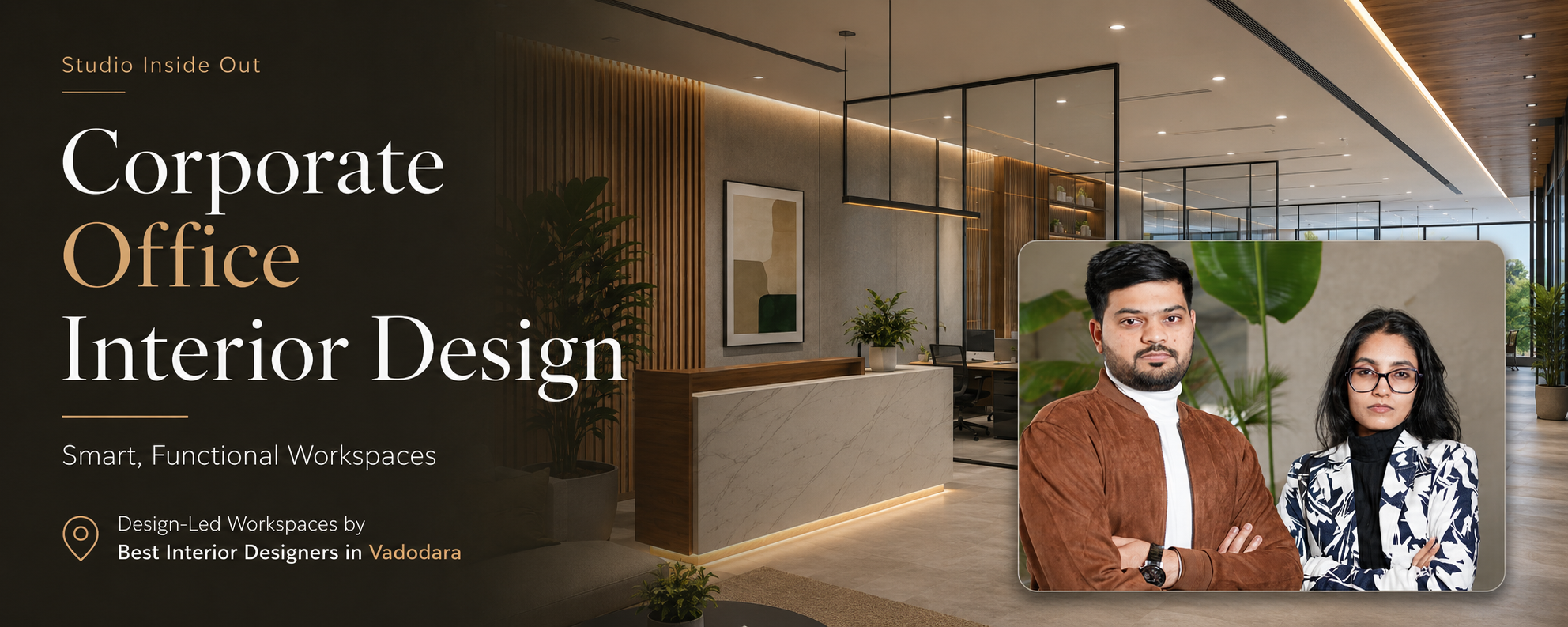
A corporate office is not just a place where people work. It is where decisions are made, teams collaborate, clients form opinions, and the brand becomes visible in real life. This is why corporate office interior design needs much more thought than selecting desks, chairs and wall colours.
A well-designed office improves the way people move, communicate, focus and perform. It also helps a company present itself with more clarity. Whether it is a small office, a growing startup, a professional firm, a corporate headquarters or a client-facing workplace, the interior design must support both people and business.
For companies looking for the best interior designers in Vadodara, the focus should not only be on visual style. The right design team should understand planning, functionality, execution, brand identity and long-term usability.
Studio Inside Out, based in Vadodara, works across interior design, architecture and planning, with a process that moves from early concept to on-site execution. Its own positioning focuses on spaces that are thoughtful, functional and connected to the people who use them.
Why Corporate Office Interior Design Matters
Many businesses treat office interiors as an expense. In reality, they are an investment in performance.
A poorly planned office can create daily friction. Employees may struggle with noise, bad lighting, uncomfortable seating, poor storage, weak meeting spaces or inefficient movement. These issues may look small individually, but together they affect productivity and team experience.
Good corporate office interior design solves these problems before they become part of daily routine.
It helps businesses plan:
Employee workstations
Private cabins
Meeting rooms
Reception areas
Waiting zones
Conference rooms
Breakout spaces
Pantry areas
Storage zones
Lighting layouts
Acoustic comfort
Branding elements
Technology integration
An office should not only look professional. It should function smoothly from morning to evening.
First Impression Starts at the Reception
The reception area is the first physical impression of the company. Before a client meets the team, they experience the space.
A strong reception design should communicate professionalism without feeling overdone. The layout should be clean, the seating should be comfortable, and the branding should be visible without looking forced.
The reception desk, wall backdrop, lighting, logo placement, material palette and visitor seating all need to work together. For corporate offices, this area should feel controlled, confident and easy to navigate.
A common mistake is making the reception too decorative and not functional enough. If the area looks good but cannot handle visitor flow, waiting time, document handling or staff movement, the design fails at the practical level.
Office Layout Should Follow Workflow
The most important part of corporate office interior design is space planning.
Before designing the look of the office, the layout must be understood. Every business works differently. A law firm, IT office, finance company, design studio, clinic administration office and real estate office will not need the same layout.
The design should answer basic questions first:
Which teams work closely together?
How many people need focused workstations?
How often are meetings held?
Do clients visit regularly?
Does leadership need privacy?
Where should support staff sit?
How much storage is required?
What technology needs to be integrated?
How should employees move through the space?
Once these answers are clear, the office can be planned intelligently.
A good layout reduces wasted space. It also reduces unnecessary interruptions between teams. This is especially important for growing companies where every square foot must be used carefully.
Workstations Need Comfort and Practicality
Workstations are where employees spend most of their day. If they are uncomfortable, cramped or poorly lit, the office will not function well.
A workstation design should consider desk size, chair quality, legroom, storage, charging points, privacy, circulation and lighting. There should be enough distance between workstations so people do not feel packed into the space.
The design should also support different work styles. Some employees need quiet focus. Some need team collaboration. Some need easy access to printers, files or discussion zones.
This is where thoughtful office planning makes the difference. A workplace should not feel like furniture has simply been fitted into a room. It should feel planned around real usage.
Cabins and Meeting Rooms Should Be Designed with Purpose
Private cabins and meeting rooms are important in corporate offices, but they should not dominate the entire layout unnecessarily.
Leadership cabins should offer privacy, storage and discussion space without disconnecting completely from the team. Glass partitions, controlled transparency and good acoustic planning can help maintain a sense of openness while still providing privacy.
Meeting rooms should be designed based on frequency and purpose. A company may need one formal conference room, but also smaller discussion rooms for quick team meetings. Not every meeting needs a large enclosed room.
Meeting room design should include:
Comfortable seating
Clear screen visibility
Power points
Video call setup
Acoustic control
Writing surfaces
Good lighting
Simple circulation
A good meeting room should help discussions move faster, not make people adjust around the room’s limitations.
Lighting Can Change the Entire Office Experience
Lighting is one of the most underrated elements in corporate office interior design.
Bad lighting can make even a well-designed office feel dull, harsh or tiring. Overly bright white lighting can feel clinical. Poorly placed lights can create glare on screens. Dim lighting can reduce focus.
The right lighting plan should combine natural light, task lighting, ambient lighting and accent lighting.
Natural light should be used wherever possible. Workstations should be planned to benefit from daylight without creating screen glare. Artificial lighting should support productivity while maintaining visual comfort.
Reception areas, cabins, conference rooms and breakout spaces can each have a different lighting mood, but the overall office should still feel connected.
Brand Identity Should Be Built into the Office
A corporate office should reflect the company’s identity. But this does not mean putting logos everywhere.
Brand identity can be expressed through colours, materials, graphics, spatial planning, wall features, furniture language and the overall tone of the space.
For example, a finance company may need a formal, refined and stable design language. A tech company may need a more flexible, open and energetic workspace. A creative agency may need collaborative zones, bold details and informal meeting areas.
The key is to avoid generic office design.
A workspace should feel specific to the company using it. That is what makes the office memorable for clients and meaningful for employees.
Materials Should Be Durable, Not Just Attractive
Corporate offices face regular use. Flooring, furniture, partitions, wall finishes and hardware must be selected with durability in mind.
A material may look good in a sample, but it needs to perform in a working office. It should handle movement, cleaning, furniture shifting and long-term wear.
Common material considerations include:
Scratch-resistant surfaces
Easy-to-clean finishes
Durable flooring
Quality laminates or veneers
Acoustic panels where required
Anti-glare glass
Strong hardware
Practical upholstery
The goal is to create an office that looks professional not only on day one, but after months and years of use.
Storage Planning Prevents Visual Clutter
A clean office is not created only by minimal design. It is created by proper storage.
Without storage planning, files, stationery, devices, samples, packaging and personal items begin to appear everywhere. This makes even a premium office look unorganised.
Storage should be planned at three levels:
Personal storage for employees
Team storage for departments
Central storage for documents and office supplies
In corporate offices, storage should be easy to access but not visually heavy. Built-in cabinets, concealed units and integrated storage walls can keep the office clean without wasting space.
Acoustic Comfort Is Important in Modern Offices
Open offices can look modern, but they often fail if acoustics are ignored.
Too much noise affects focus. Calls, conversations, meetings and movement can disturb employees throughout the day. This is why corporate office interior design must include acoustic planning.
Acoustic comfort can be improved through:
Soft furnishings
Acoustic wall panels
Ceiling treatments
Carpet tiles
Partition planning
Meeting room insulation
Strategic zoning
A productive office is not always the most open office. It is the office where people can work without constant disturbance.
Breakout Spaces Improve Team Culture
Modern offices need more than desks and meeting rooms. Breakout spaces are important for informal discussions, short breaks and team interaction.
A good breakout zone does not need to be large. It needs to be placed correctly and designed with purpose.
This area can include casual seating, a pantry counter, a coffee point, informal meeting seating or a relaxed discussion corner. It gives employees a space to reset without leaving the office.
For companies that want better team culture, these small spaces matter.
Why Hire Professional Interior Designers for Corporate Offices?
Corporate office design involves many decisions that affect daily operations. This includes space planning, furniture sizing, services, electrical points, lighting, materials, branding, storage, acoustics and execution details.
Professional interior designers help connect these decisions into one clear plan.
For businesses searching for the best interior designers in Vadodara, the right design partner should be able to understand the business first and then design the space around it.
Studio Inside Out’s approach is built around understanding the space, the user’s needs and how the space should feel before the design takes shape. The studio also highlights end-to-end involvement, from the first sketch to final on-site execution.
Corporate Office Interior Design in Vadodara
Vadodara has a growing mix of businesses, professional offices, corporate setups, clinics, studios, educational spaces and commercial establishments. As businesses become more client-facing and team-driven, office interiors are becoming a serious part of brand building.
A well-designed office can help a company look more credible, improve employee experience and make better use of available space.
For Vadodara-based businesses, working with local interior designers also helps because the team understands local site conditions, material availability, vendor coordination and execution challenges.
Studio Inside Out is located in Vadodara and provides interior design and architectural planning services from its office at Vihav Trade Center, Vasna-Bhayli Road.
What Makes a Good Corporate Office Interior?
A good corporate office should feel clear, efficient and aligned with the business.
It should have:
A functional layout
A professional reception
Comfortable workstations
Well-planned cabins
Practical meeting rooms
Good lighting
Strong storage planning
Durable materials
Clear circulation
Brand consistency
Acoustic comfort
Scope for future growth
The best office interiors do not depend on expensive materials alone. They depend on smart decisions.
Final Thoughts
Corporate office interior design is about creating a workplace that supports people, operations and brand image at the same time.
A good office should help employees work better. It should help clients trust the company faster. It should help leadership manage the team more efficiently. Most importantly, it should be planned for real daily use, not just for photographs.
For businesses looking for the best interior designers in Vadodara, the priority should be a design team that understands both creativity and execution.
Studio Inside Out brings planning, interior design and on-site execution thinking together to create spaces that feel refined, functional and connected to the people using them.
CTA
Planning a new corporate office or renovating your existing workspace?
Connect with Studio Inside Out for corporate office interior design that brings better planning, stronger functionality and a more professional brand experience to your workplace.
SEO FAQs
What is corporate office interior design?
Corporate office interior design is the planning and design of workplace interiors, including reception areas, workstations, cabins, meeting rooms, lighting, furniture, storage, branding and circulation.
Why is office interior design important?
Office interior design improves productivity, space usage, client experience, employee comfort and brand presentation. A well-planned office can reduce daily workflow problems and make the workplace more efficient.
How do I choose the best interior designers in Vadodara for an office project?
Look for interior designers who understand space planning, workflow, material selection, lighting, storage, execution and brand identity. The right team should design around your business needs, not just visual references.
What should be included in a corporate office interior?
A corporate office should include a functional layout, reception, employee workstations, cabins, meeting rooms, storage, lighting, branding, pantry or breakout space and proper service planning.
Can a small office also have professional interior design?
Yes. Small offices benefit greatly from professional interior design because smart planning can improve storage, seating, movement, lighting and overall space efficiency.